SEASONS | RESOURCES
Ordinary Time
Ordinary Time is the long season of learning to follow the way of Jesus in the everyday. After the celebrations, feasts, and dramatic turns of the Christian story, we return to familiar streets, regular routines, shared meals, work, neighbors, and all the seemingly small moments where a life is actually formed. Ordinary Time reminds us that most of life happens here and God is here too.
“How I spend this ordinary day in Christ is how I will spend my Christian life.”
ABOUT THE SEASON
Ordinary Time is the longest season of the liturgical year. Its color is green: the color of growth, life, and things slowly becoming what they were made to be.
There are no forty days to count down. No candles to light each week. No great feast waiting just around the corner.
There is simply life.
Jesus walking from town to town. Meals around tables. Questions from strangers. Stories told along roadsides. Sick people brought by friends. Children welcomed. Arguments with religious leaders. Boats, fields, weddings, grief, bread, fish, and ordinary people learning a different way to live. Ordinary Time invites us into that same slow apprenticeship.
It reminds us that formation rarely happens all at once. We become people of love through the thousand small ways we practice love. We become people who know our neighbors by learning names, showing up again, sharing meals, paying attention, staying curious, and choosing to remain present to a place.
The ordinary is not something we need to escape in order to find God. It is where we learn to notice God.
RESOURCES FOR ORDINARY TIME
Rhythms
Ordinary Time invites us to be rooted. To walk the same streets. Shop at the same stores. Sit on the same porch. Learn the names of the people we regularly pass. Watch the seasons slowly change around the places we call home. These rhythms are an invitation to resist the idea that meaningful life is always somewhere else and instead become more present to the people and places already around us.

Prayer for Noticing & Naming
Father in Heaven,
Our genesis is with Your instruction
To notice and name
And join You in the holy work of nomenclature.
May we accept Your invitation to notice and name
That You are in this place.
May noticing be an act of worship.
May naming be an act of blessing.
May we notice our shared humanity
And name both the triumphs of human hearts,
And the tragedies of our human condition.
May we notice epiphanies of Your colorful Creation
And name each day what is good, true, and beautiful
In our neighbors and neighborhoods.
May we notice the sacredness of the people around us,
And name our ancestors who lived faithful lives
Of service and sacrifice on this soil.
May we be witnesses each day of the divine mysteries
Noticing and naming Your mercy, love, and grace.
May noticing and naming form
Our minds to be curious,
Our hearts to be compassionate,
And our souls to be curates—
As we seek Your will
And follow Your Way.
Amen.
Prayers









Practice | Neighborhood Map

The first practice is to listen.
To love a person, or a place, we begin by listening. Listening is how we cultivate connection. The invitation is to be generous with our attention. Listening invites us to give honor and focus through our senses. At the root of all formation and transformation is an awareness. Awareness begins with listening.
Listening is an act of worship. “Hear, O Israel…” is known as the Shema, the central affirmation of the Jewish faith. The first principle and foundation in worship is to hear. The practice of listening to our place may be the pathway to our best prayers.
“Listen to your life…” wrote Frederick Buechner. The noise, both external and internal, makes that invitation seem impossible at times. With any practice, the best practice is to start small.
Walk out the front door, without the phone, around the block… and listen.
Drive with the windows down, and the stereo off… and listen.
Stand in line at the store, the school, the coffee shop, or the shopping center… and listen.
Practice Listening to Your Place
What brings a smile when you hear it in your neighborhood?
What noises cause concern when you hear them in your neighborhood?
What are the confusing voices and messages you hear in your neighborhood?
What are the hopes you hear for your neighborhood?
Practices









Featured Place | Neighborhood

“It is by the place we’ve got, and our love for it and our keeping of it, that this world is joined to heaven.”
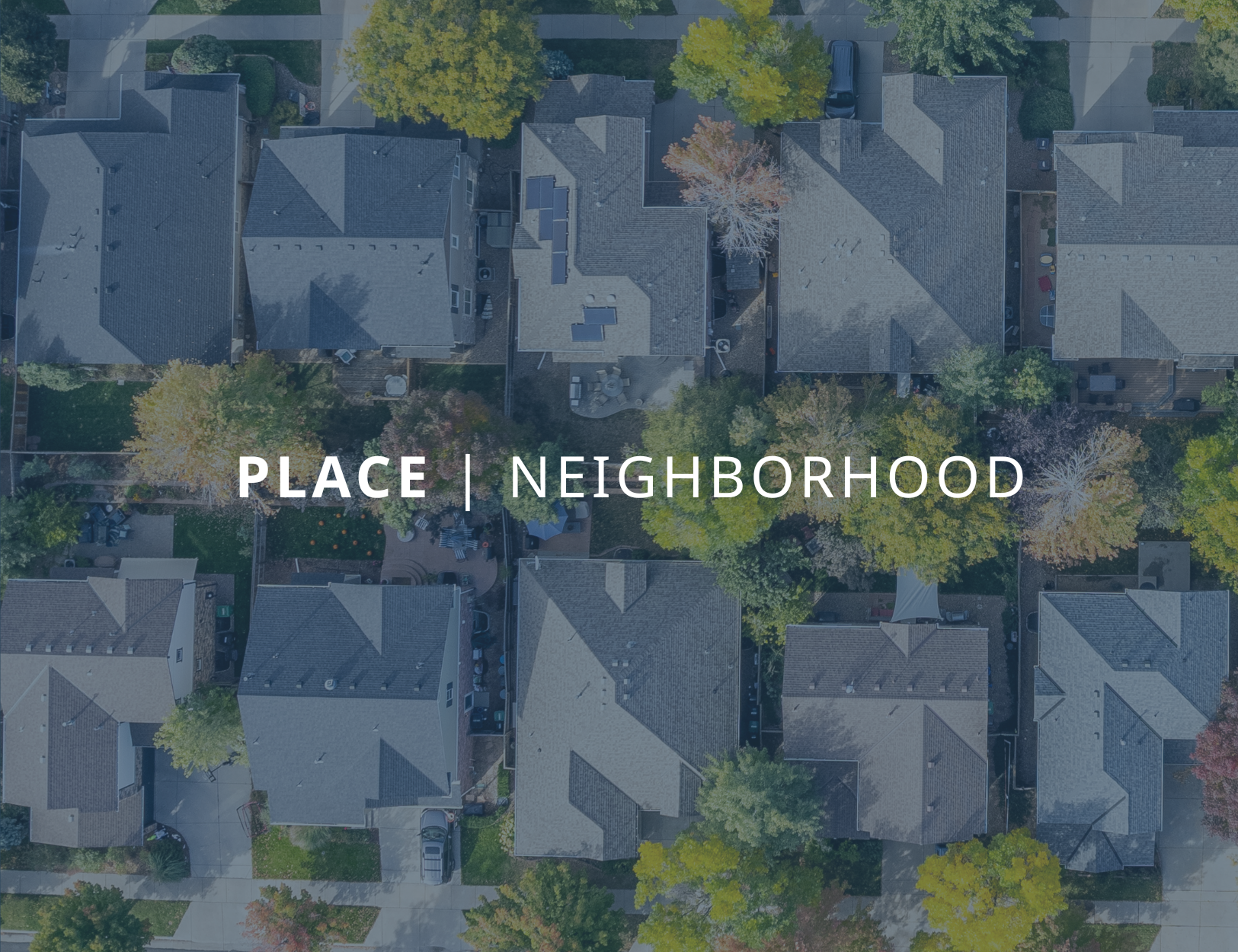
The neighborhood is a sacred place. We too often come and go from neighborhoods without intention or attention. Our sidewalks can become ordinarily familiar, the houses and people passing by in a blur. But our neighborhood—our block, our street, or our apartment building—is sacred. It’s where the story of God, people, and place intersect.
God’s first question in Scripture is about place. “Where are you?” God’s inquiry was not for His benefit—it is for ours. And it still is. At the beginning of human history, God is working in a specific place, a garden in the east, in Eden. At the fulcrum of human history, God is present again in the person of Jesus, living and working in specific places: in Galilee, in Jerusalem. And it is in the place called Golgotha, the place outside the city, that his blood enters the dirt He created. From Creation to the cross, we are in a story of place.
Our neighborhood is ordinary. But God has always inhabited ordinary places. Mailboxes, porch lights, and recycling bins. Dogs barking, kids shouting, and sprinklers spraying. The home of the neighbor who has lived here for decades and the home of the new-to-the-city neighbor. The new coffee shop and the old corner gas station. These all form a liturgy of place with holiness hidden in plain sight.
Our neighborhoods are the actual location of spiritual formation. It is here we learn to be present to God, to our neighbor, and ourselves. Real neighbors have real needs. And real proximity often reveals real tension. To love our neighbor is not to exist in the absence of difficulty; instead, it is God’s presence that invites us to be formed as we navigate it. If we can see our neighborhood in this way, even conflict becomes an opportunity to grow in grace.
Our neighborhoods provide specificity to the concept of “love your neighbor.” The names of those who live next door are not an abstract concept, but physical beings deeply loved by God that we are invited to learn to love as He does. Our neighborhoods are often the environment where we have the unique opportunity for learning from longevity. Living in the same location for years re-forms us in the patient process of becoming a good neighbor. Our neighborhoods are places of reciprocity. Learning that love of neighbor does not only give, it also receives.
God is already present and at work in the lives of those in our neighborhood. When we learn to open our eyes, our hearts, and our hands, we join Him in what He is doing. The invitation to participate in the story of God by loving our neighbor is just outside our front door. The neighborhood is a sacred place.
Places






RESOURCES FOR EASTERTIDE
Recommended Books
These resources explore Pentecost, life in the Spirit, and the calling to become people through whom the love of God takes local form. Read slowly. Stay curious. Pay attention not only to what the Spirit might be doing in you, but also to what the Spirit might be inviting you to notice and join around you.
-

Living the Resurrection: The Risen Christ in Everyday Life
Eugene Peterson’s invites us into the stories of the Resurrection to experience wonder through the eyes of the biblical witnesses, and discover how the practices and perspectives of resurrection life transform your daily work, your daily meals, and your daily relationships.
Living the Resurrection has had a profound influence on my ministry and writing. Peterson is among the few who write about the Resurrection in the present tense―as a reality for us to live into and experience in the here and now. I’m grateful for this summons to not just believe but experience the center of our faith―today.
Robert Gelinas, Lead Pastor of Colorado Community Church, author of Discipled by Jesus
-

Surprised By Hope
Wright convincingly argues that what we believe about life after death directly affects what we believe about life before death. For if God intends to renew the whole creation—and if this has already begun in Jesus’s resurrection—the church cannot stop at "saving souls" but must anticipate the eventual renewal by working for God’s kingdom in the wider world, bringing healing and hope in the present life.
-

Bitter and Sweet: A Journey into Easter
Tsh Oxenreider, author of Shadow and Light: A Journey into Advent, uncovers what it means to participate in the liturgical traditions of Lent including artwork and music that illuminate the impact - both personal and global - of Jesus’s death and resurrection.
-

Bread and Wine: Readings for Lent and Easter
The Plough’s Bread and Wine provides readings ecumenical in scope, and represents both classic and contemporary Christian writers.

More rhythms to root your faith in place.