RHYTHMS | PRAYER, PRACTICE, PLACE
Vol 4. Issue 8
Friends,
This issue considers how the cultivation and care for plant life can contribute to the love for our neighbors and neighborhoods.
It includes a creative Prayer by Michelle Stinson, An Ode to Indoor Plants, the Practice of Sharing Plants, and a Plant Sale as a sacred Place.
Our hope is that these rhythms of a Prayer, Practice, and Place encourage you in deepening the roots of your love for your neighbors and neighborhood.
All blessings.
Jared Mackey
P.S. Information about the Denver Master Gardener Plant Sale on May 16 & 17 is included below.

PRAYER | AN ODE TO INDOOR PLANTS

By Michelle Stinson
Thanks be to God,
the Father Almighty,
the Creator of heaven and earth,
who delighted in making
the families of plants
who call our homes
their home.
For my potted pothos plant,
whose tenacity in adversity
astounds me still.
Its severed vine
when placed in water
brings forth roots to start anew.
For my monstrous monstera,
whose growthy gratitude
warms my heart.
Once discarded,
now placed in a new home,
flourishes with loving care.
For my flying-saucer friendship plant,
originally gifted
now generously giving.
Tiny new sprouts,
shooting up from the soil,
become gifts to give away.
For my over-wintering trumpet vine,
productive in its waiting
to return to summer soil.
All winter long,
its tendrils stretch and grow,
reaching ever for the sun.
For each of our plants
and the graces they display,
we offer a prayer of thanks
to the God who
—like the stars— (Ps 147:4)
must know them all
by name.
Amen.
For the plant curious among us, the pothos and monstera are both part of the Araceae family, the friendship plant belongs to the Urticaceae family, and trumpet vines reside in the Bignoniaceae family.
Michelle Stinson is currently delighting in a season of writing, teaching, and getting her hands in the dirt. She regularly speaks and writes on food, hospitality, land care, and the Psalms. She is a Visiting Scholar in Old Testament (Denver Seminary) and a newly certified CSU Colorado Gardener.
PRACTICE | SHARING PLANTS

By Jared Mackey
Practice
Divide with generosity. Plan for at least a 50/50 division. Give a portion large enough to be enjoyed in the first season.
Match the plant to the person. Set people up to succeed. For new gardeners, share “bulletproof” plants; for experienced ones, offer something more particular.
Divide in the right season. Early spring (when many plants are still dormant) is an opportune time; fall works for other varieties, too. Avoid dividing in the heat of summer.
Make giving easy. Pot a division, add a simple note (plant name + sunlight needs), and leave it out on the sidewalk with a friendly sign “Free Plants.”
“Plants are naturally intended to be shared.”
Sharing plants is more than just sharing the organic material. It is sharing a living connection with family, friends, and neighbors. Geoff Ledgerwood’s roots are in rural Washington state. It’s there that he inherited generational wisdom about the neighborly practice of dividing plants.
Dividing plants is a practice of generational generosity for Geoff. “This has been something generational in my family. I can remember my grandmother dividing plants with her friends and family,” he shares with delight. “In my yard, I have plants that go back to my grandparents and great-grandparents. It’s a sweet legacy for me to have those growing in my yard, perpetuating a legacy not only of plants, but a legacy of family.”
Geoff shares his perspective with infectious generosity. “Plants are naturally intended to be shared.” Perennials flourish when they are divided. There is an inherent multiplication in their division. But it is not only the organic plant material that is shared. There is a generosity of rooted wisdom that is passed on in sharing plants. “There’s toil when it comes to growing things.” Geoff shares humbly. “I’ve killed more things than I’ve ever kept alive,” Geoff says with both a levity and reality that echoes anyone who has had their hands in the dirt for any length of time. “There’s a shared struggle, and when you’ve had some success, you want to share that wisdom with others.”
He hints at a universal truth of conversation and connection. “Plants keep you in conversation with people.” Those things that require our care connect us to others. “Plants, pets, and kids are always conversation starters.” Geoff jokes.
The specificity of the plant determines when digging it and dividing it is most beneficial. “Generally speaking, what blooms in the spring you plant in the fall, and what blooms in late summer you plant in spring.” Geoff’s generational wisdom is seen in his selection of what plants to divide and share with different audiences. “There are some plants you might not be ready for.” “Begin with bulletproof plants that are easy to grow and share.” With time and experience, there’s the opportunity to grow into tending and sharing 201 and 301 horticultures.
Where to begin in sharing plants with neighbors? Geoff suggests, “Dig up and divide plants and put them in some old pots with a sign that says free plants next to your street. People will come take them and come back around when they see you working in the yard to talk more.” Where could the practice of dividing and sharing plants lead? “There are yards full of flowers down my grandparents’ street in their neighbors’ yards that were divided and shared with them.” Geoff shares with a nostalgic tone in his voice. “My mom always said, ‘Even if you don’t like a flower, it’s always beautiful.” The practice of dividing and sharing plants is like a flower; it’s always beautiful.
Thank you to Geoff Ledgerwood for his winsome perspective on both people and plants and his contribution to this article.
PLACE | PLANT SALE

By Jared Mackey
“God said, ‘Let the land produce vegetation: seed-bearing plants and trees on the land that bear fruit with seed in it, according to their various kinds.’ And God saw that it was good.”
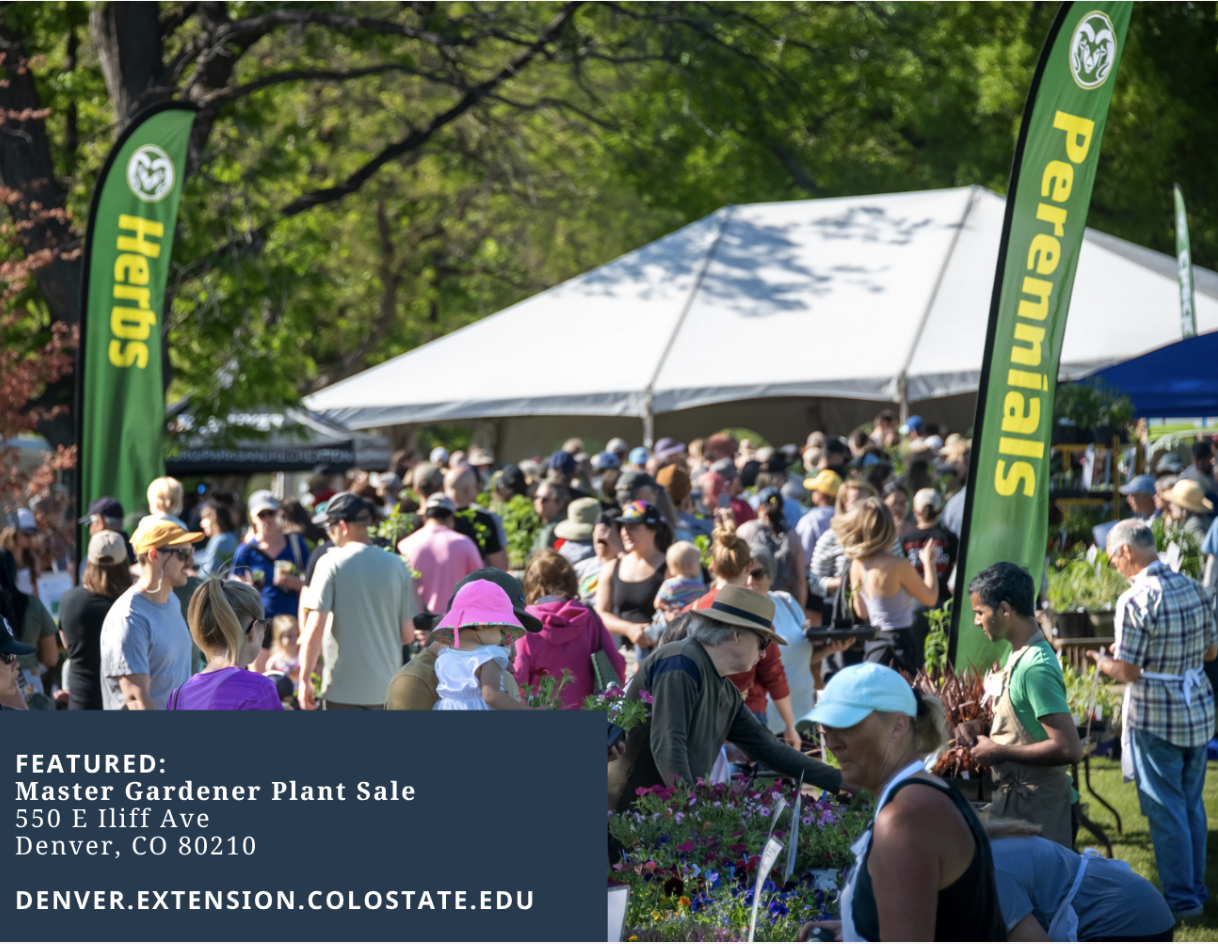
A plant sale is a sacred place. It is a convergence of care that cultivates plant life in a particular place. It is an intersection of community activation, education, and commerce—all to connect people more deeply with plants and place.
The Denver Master Gardner Plant Sale is an initiative of the Colorado Master Gardener program, a unique intersection between Colorado State University horticulture expertise and volunteers from the community who are invested in educating others locally. There are 135 Master Gardeners active in Denver. Together, they contribute approximately 5,000 volunteer hours annually. The Denver Master Gardener Program is through Colorado State University Extension, focusing on gardening in the unique context of urban Denver conditions. They maintain three demonstration gardens in Harvard Gulch Park for research, education, and outreach. A passion for plant life in the city animates those in the Denver Master Gardener program. It is a rooted way of loving their neighbors by generously sharing their horticultural knowledge.
Each spring, the Master Gardner Plant Sale extends the education and outreach of the program to hundreds of people over two days. Over 8,000 plants grown in the greenhouses at Harvard Gulch, along with annuals and perennials, are available. The plants have been carefully cultivated to adapt to Colorado’s high altitude climate, drought conditions, and short growing season. Heirloom tomatoes, chilies, and herbs, along with extensive varietals of many vegetables, can be purchased at the plant sale, beginning at only $7. The quality of plants is only exceeded by the quantity of knowledge of the Master Gardeners who host the plant sale.
A transplant to Denver in the last decade, Jennifer Coggins, attended the Master Gardener Plant Sale for the first time in 2025. “We are from North Carolina. It is a lot easier to be a gardener in North Carolina than it is to be a gardener in Colorado.” Jennifer shares in honesty and humility. But her delight was in the harvest from the tomatoes she purchased at the plant sale. “I’ll say we only tried a few, but last year was our best year yet! We did a lot from two small beds.” Jennifer confesses joyfully, “We probably bought too many plants. But I feel like those are the right things to overbuy, right?” Her joyful optimism is obvious: “Gardening is an act of hope.” The plant sale is an annual gathering of those, like Jennifer, who believe and cultivate that growing food in your backyard is a better way to live.
Unlike God, who first spoke plant life into existence, our seeds and plants always come from someone or somewhere beyond ourselves. A local plant sale hosted by citizens with a deep commitment to horticultural cultivation and care is an ideal place to source seeds and plants. A plant sale is where we are invited to join God in the good work of cultivating and caring for Creation. A plant sale is a sacred place.
Thank you to Jennifer Coggins for her conversation and contribution to this article.
PARTICIPATE | ART & PLACE


THURSDAY, APRIL 23, 2026 6-9 PM
Art & Place
See and celebrate the work of six local artists on Thursday evening, April 23, at ArtGym. There will be an artist panel exploring the often unseen influence of place on art and asking how art can inspire us to love the people and places around us.
Drinks and hors d'oeuvres provided.
Spend an evening this spring celebrating the beauty of art and place.

More rhythms to root your faith in place.
Sacred Place provides a beautiful bi-weekly publication to share the rhythms of a Prayer, Practice, and Place as simple ways to help cultivate love for our neighbors and neighborhoods.