RHYTHMS | PRAYER, PRACTICE, PLACE
Vol 4. Issue 1
Friends,
This issue includes a Prayer for our Noticing & Naming, the Practice of a Nature Notebook by nonprofit leader and spiritual director Chris Hess, and the History Museum as a sacred Place.
Our hope is this issue cultivates curiosity for the places and people around you. We live in a beautiful world and are invited into the holy work of noticing it and naming it.
All blessings.
Jared Mackey
P.S. We’re thrilled to partner with local musical artists Jake & Jubilee to host Sound & Place on February 5.Ticket information below.
PRAYER | NOTICING & NAMING

By Jared Mackey
Father in Heaven,
Our genesis is with Your instruction
To notice and name
And join You in the holy work of nomenclature.
May we accept Your invitation to notice and name
That You are in this place.
May noticing be an act of worship.
May naming be an act of blessing.
May we notice our shared humanity
And name both the triumphs of human hearts,
And the tragedies of our human condition.
May we notice epiphanies of Your colorful Creation
And name each day what is good, true, and beautiful
In our neighbors and neighborhoods.
May we notice the sacredness of the people around us,
And name our ancestors who lived faithful lives
Of service and sacrifice on this soil.
May we be witnesses each day of the divine mysteries
Noticing and naming Your mercy, love, and grace.
May noticing and naming form
Our minds to be curious,
Our hearts to be compassionate,
And our souls to be curates—
As we seek Your will
And follow Your Way.
Amen.
PRACTICE | NATURE NOTEBOOK

By Chris Hess
Practice
Get a Notebook. A real, paper notebook is helpful. Preferably one that fits in a pocket. In addition to a notebook, a favorite writing implement. You know you have one.
Find a Place. What slice of the natural world can you access right now? It may be a stretch of urban sidewalk, a greenbelt in the suburbs, a bird feeder on your balcony, or a clearing in the woods. It’s all crammed with heaven. Be intentionally present to that place at least once a week.
Write It Down. Put pen (or pencil) to paper and write what you notice. What do you notice? What changes? What stays the same? It could be two words, a sentence, or a paragraph. Are you reminded of something else—a poem, artwork, song, or memory, etc.?
Return. At the end of each month, read back on the entries in your notebook. What do you notice? What is God inviting you to?
“I just need to have long periods of no talking and no special thinking and immediate contact with the sun, the grass, the leaves; undistracted by statements, jokes, opinions, news...”
I live in the middle of the Buckinghorse neighborhood in Ft. Collins, developed in the mid-2010s on what was the Jessup family farm. The trees along the streets have 10 years of growth on them and feel permanent. Some of us have gardens that are the destination of evening walks, some of us don’t. The natural world of the neighborhood is always at work.
Just one block over from our house is a walking path. Take it east a bit, and I’m presented with options. I can continue east, through the new neighborhood park, and eventually end up at the recently completed stretch of the Poudre River trail. Before it was completed, I’d traverse over a busted-down green gate and follow the footprints of dog walkers in the dirt and snow. This took me to a big cottonwood, with Bullock’s Oriole nests hanging from the branches by the dozens. Thankfully, the cottonwood was left alone and routed around when they paved the trail. Most folks likely pass by these days without noticing the treetop neighborhood just 20 yards away.
Or, I can hang a left and take the sidewalk past some storage units and cross the street to the Prospect Ponds Natural Area. These two ponds used to be gravel quarries, with companies rerouting the Poudre River in order to get at the natural resource in the river bed. The current beauty of this place is a bittersweet testament to “progress” and the healing power of nature. On the east side of the natural area, there is a game trail that follows the bends of the river. After a late spring storm 4 years ago, a handful of old trees snapped under the weight of the wet snow. Walking the path with a friend afterwards was shocking. The ways we knew to go were blocked. We had to be curious and find new ways. On one walk, my friend Katrina said, “Isn’t it a privilege to become so familiar with a place that we get to notice how it changes around us?”
These are notes from being present to the nature of the neighborhood where I live. These are observations of the sacred place I am called to call home: a neighborhood in Ft. Collins, built on old farm land, built on land stewarded by the Arapahoe people, and unknown inhabitants further back than that. These are the markings of simply noticing what is going on in the created world around me, allowing that to be enough, and wondering with the Loving Creator, “What is my place here?”
Being freely & lightly attuned to the natural world around us reminds us of the patient pace of the Creator. This is not something to accomplish, but something to enter into, because it’s all happening anyway, and we aren’t at the center of any of it. We are invited to meet God in the wonder, enjoyment, and grief of it all.
Chris Hess is the director of The Abbey and the Denver Seminary Soul Care Initiative, inviting Colorado's pastoral and nonprofit leaders to rest, be cared for, and remember their unqualified belovedness. Chris pastored for 17 years in Ft. Collins, CO, where he still lives with Jessica & their four kids. After living all over the city, they are happy to call the Buckinghorse neighborhood home.
PLACE | HISTORY MUSEUM

By Jared Mackey
“he great force of history comes from the fact that we carry it within us...history is literally present in all that we do.”
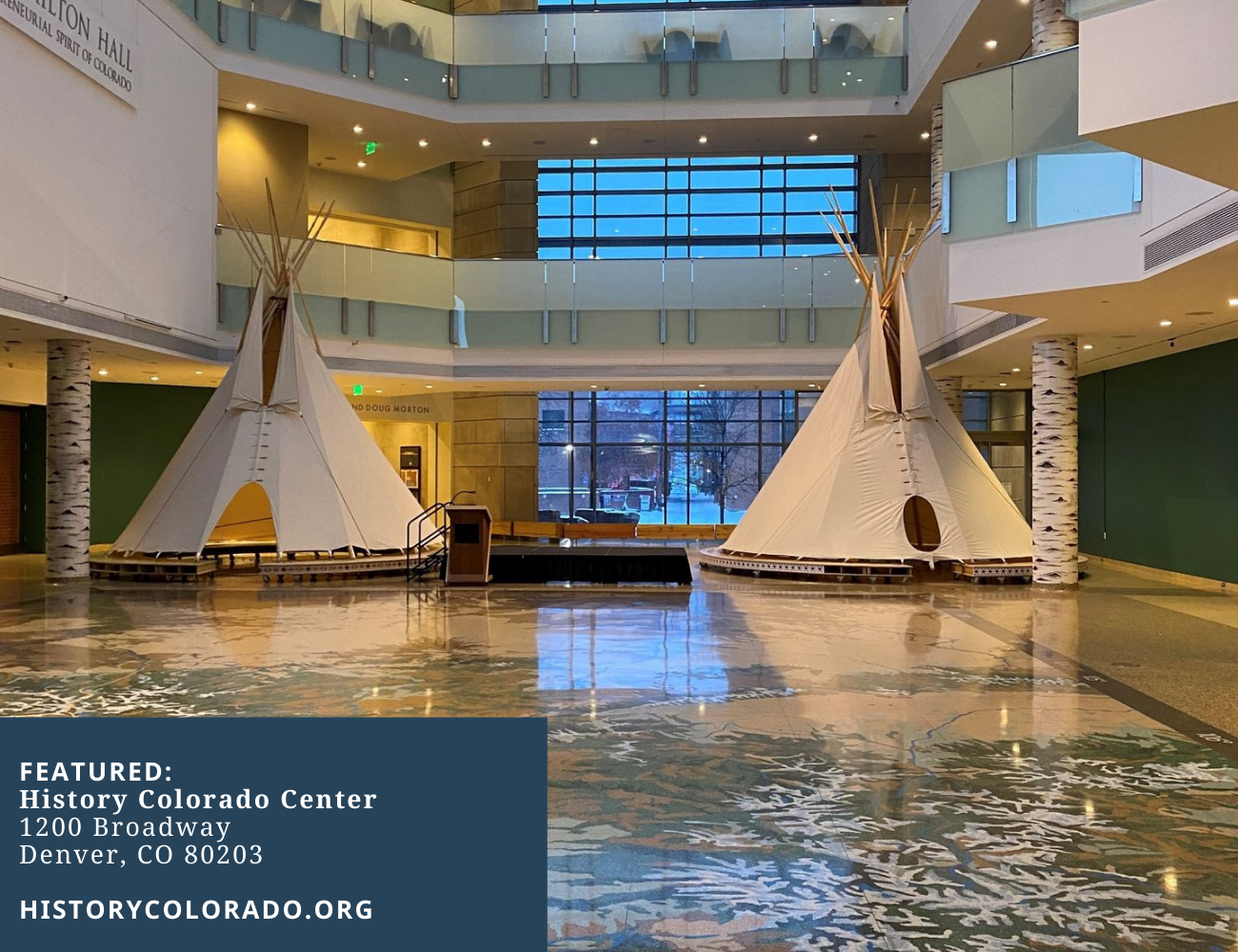
A history museum is a sacred place. It is a place that holds both the joyful and painful, ordinary and extraordinary stories of the past. It is a place to learn from different perspectives and grow through collective memory.
The Colorado State Historical and Natural History Society was established in Denver in 1879. The dividing interests between cultural and natural history would lead to a separate Museum of Natural History (now Museum of Nature and Science) and History Museum. Over the years, the Colorado History Museum would occupy various facilities in the Civic Center complex, growing an astounding collection of over 1 million artifacts. A new chapter for the museum began when the History Colorado Center opened on South Broadway in 2012 with a four-story atrium featuring a terrazzo floor depicting a 40-foot by 60-foot map of Colorado.
Terri Gentry is History Colorado’s Engagement Manager for Black Communities. We met in the Lincoln Hills section of the Colorado Stories exhibit to discuss the importance of the history museum. Lincoln Hills was a mountain resort where Black families vacationed in Colorado during segregation. For Terri, the history of Lincoln Hills is personal. Her family owned a cabin there. As a child she would climb the mountain behind the cabin taking in the wide views that made the world feel bigger. Terri shared the stories of her family and how the Black community contributed to the history told through the Lincoln Hills exhibit.
“What History Colorado is doing; is they are giving a voice to each person in this state. They are acknowledging history from all these different perspectives.” Terri provides invaluable insight into how History Colorado is willing to continually learn how to listen to the past from different perspectives. This posture is displayed in the work they have done with the Arapahoe and Cheyenne Nation over the last decade to revamp and revoice the exhibit on the Sand Creek Massacre. “History Colorado is working very hard to make sure that everything is recognized and acknowledged.”
In 2026, History Colorado will feature the exhibit “150/250” as the United States will mark the 250th anniversary of the Declaration of Independence, and in the same year, Colorado will mark the 150th anniversary as a state. As the Centennial State, Colorado is the only state observing the twin anniversaries. It is an important year for Coloradans to consider the stories and experiences of those who lived in this place before us.
Terri offers timely wisdom on why a history museum is important for our cultural moment. “It helps me celebrate my ancestors for everything that they did to make my life what it is. I look at what they've done, and if they hadn't been here and done what they did, I wouldn't be here. So, for me, it's the daily way I want to honor and be grateful to the people that were here before me.”
A history museum is a place to remember. It is a place to learn from the overlooked or unknown narratives of our past. It is a place that invites us to hold with objectivity the complexity of our collective memory. It is a place that holds centuries of stories of our neighbors and neighborhoods. A history museum is a sacred place.
A special thank you to Terri Gentry for her contribution to this article and her ongoing commitment to graciously holding history and sharing the stories of our state with dignity for all people.
PARTICIPATE | EVENTS


You are invited to Sound & Place, a concert designed to explore how musical sound connects us with place.
The event will be a unique concert experience with an artist panel reflecting on the unseen influence of place on how we hear and asking how musical sound might inspire us to better love the people and places around us.
Purchase tickets for an evening celebrating the unique energy of Sound & Place on Thursday, February 5, 6:30pm.

More rhythms to root your faith in place.
Sacred Place provides a beautiful bi-weekly publication to share the rhythms of a Prayer, Practice, and Place as simple ways to help cultivate love for our neighbors and neighborhoods.