RHYTHMS | PRAYER, PRACTICE, PLACE
Vol 3. Issue 21
Friends,
Our commitment is to help you cultivate an imagination about the integration of faith and place, including where it is often difficult and at times divisive.
Our focus in this issue is on local government, a Prayer for our Mayors, by Corbin Hobbs, and articles from conversations with two city council members on the Practice of City Council Meetings, and a City Council Chambers as a sacred Place.
Civic leaders are charged with the responsibility to care for our neighbors and neighborhoods. Our hope is this issue encourages you to engage and encourage those who serve and lead in local government.
All blessings.
Jared Mackey
P.S. We have curated Civic Rhythms and Resources on sacredplace.co to explore and encourage the intersection of our faith with our civic responsibility.
PRAYER | MAYORS

By Corbin Hobbs
Father in Heaven,
Thank you for our city.
We love our city.
You love our city.
You are the one who raises up leaders.
All authority comes from You. (Romans 13:1)
Today, we pray for our mayor.
We pray wisdom over them.
Grant them wisdom that is pure, peaceable, gentle,
Open to reason, full of mercy and good fruits. (James 3:17)
Let their decisions be guided by justice and righteousness,
For by righteousness a city is exalted. (Proverbs 14:34)
We pray compassion over them.
Give them a heart that seeks the welfare of this city,
To act not in selfish ambition but in service to everyone. (Philippians 2:3-4)
May they defend the cause of the poor, the needy, and the vulnerable, (Proverbs 31:8-9)
And work for peace and unity among all our neighbors.
We pray humility over them.
Surround them with wise counselors who fear you. (Proverbs 11:14)
Protect them from pride and weariness.
May they be a servant-leader
Who humbly acknowledges that the earth is Yours,
And all who dwell in it. (Psalm 24:1)
May our city flourish under their leadership.
In Jesus’ name,
Amen.
Corbin Hobbs is the Lead Pastor of The Heights Church. He currently serves on the Mayor’s Clergy Council for the city of Denver. Corbin and his family live in the Lowry neighborhood.
PRACTICE | CITY COUNCIL MEETINGS

By Jared Mackey
“City council is the place where a citizen’s voice is the most heard.”
Practice
Educate. Attend your city council meeting and listen to issues at the local level.
Curiosity. Consider other perspectives and passions for issues in your city.
Empathy. Hear the history and backstory that has formed people’s positions.
Character. Be a voice of support or opposition with integrity.
Andrea Peters has served on the Littleton City Council for the last two years. She shares her conviction about the essential nature of citizens’ participation in city council meetings. “On our flowchart, citizens are at the very top. If we don't hear from them, the whole system breaks down," she explains. With a mix of optimism and realism, she adds, "I think [local city council meetings] might be the most hopeful part of government right now."
Citizens want their voice to be heard and influence the trajectory of the city. From passionate discussions about the materials to use on trails to the preservation of historical places and the safety of children riding to school, city council meetings are where neighbors shape outcomes. Andrea shares from her own experience on one issue for the Littleton City Council, “The conversations people had on an issue, advocating over and over for what they wanted…they changed my mind, and they changed three other council members' minds.”
City council meetings are where the critical questions of democracy are worked out every week. Do I trust this system to protect, defend, and represent me? When you are a regular presence at city council meetings, you begin to witness the complexity behind decisions that may seem simple from afar. You witness council members investing time to listen with nuance to the issues that affect real neighbors in real ways. Your presence communicates to elected local officials that citizens are proactively engaged in city outcomes. In the process, you become a more informed neighbor about community issues. You are aware of the depth of discussions and the passionate differences in convictions.
A way to begin the practice of participating in city council meetings is to approach each meeting with curiosity rather than predetermined conclusions. Ask yourself: "What might I not yet understand about this issue?" This posture opens doors for dialogue rather than defensiveness as a default. Andrea provides an important insight: “For every ordinance you support, there's an ordinance someone else supports, and you're against." Participating in city council meetings will require learning to listen longer and becoming a more differentiated individual.
Creating a communal presence at city council meetings with like-minded neighbors is valuable. Coordinated groups with proactive agendas and positive attitudes—even when they do not immediately prevail—have more influence than isolated voices. Communicating support for an issue, not only opposition to issues, is important. The majority is often silent. A handful of citizens may dominate discussions, leaving elected officials uncertain about broader community sentiment.
When you practice participating in city council meetings, you are stewarding the responsibility of caring for your neighbors and neighborhood. You are communicating through your presence that place matters, neighbors matter, and the messy, hopeful work of local democracy matters.
Thank you to Andrea Peters for stewarding the responsibility for citizens in her city and her conversation and contribution to this article.
PLACE | CITY COUNCIL CHAMBERS

By Jared Mackey
“This is a place where people are making decisions about how we live together.”

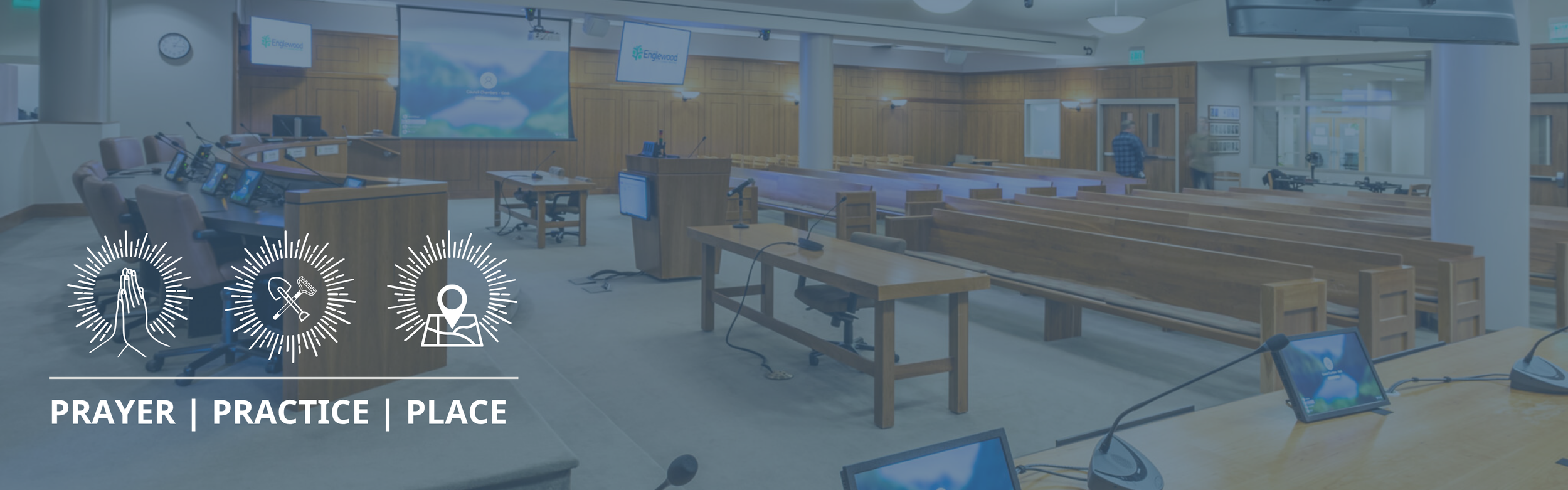
A city council chamber is a sacred place. The architecture is distinct—the wooden dais, with a raised crescent shape to both facilitate conversation and differentiate the elected council from community members, and the podium for citizens to take the stand to make public comment. What makes it sacred, is the work neighbors do to shape the future of their neighborhoods. A city council meeting is where an elected group of neighbors come together with the responsibility to care for both people and place.
City council meetings represent what Chelsea Nuunenkamp, Englewood City Council member, calls "the purest form of democracy.” She offers a foundational perspective from Neil Postman’s work on the importance of the information-to-action ratio. “Most individuals take in a lot of information at the level of government where they can take the least amount of tangible action.” Chelsea continues with both conviction and compassion in her voice, “I think it's really important because I think one thing that leads to despair is taking in a lot of concerning information without the ability to do anything about it. But the more we can align our information and our action locally, the more I think we can wake up to the opportunities that exist in our own communities.”
Local city council meetings offer accessibility and shared responsibility. "It's so much easier to come talk to me than it is to Michael Bennett or John Hickenlooper," Chelsea explains. "I am at City Hall just down the street every Monday night. Or you can catch me in the park or at the grocery store." This local proximity transforms governance from an abstract concept into a neighborhood conversation. The tangible elements that shape daily life flow from decisions made on the local level. “If you want to be able to buy a house and go on walks in your neighborhood and access a library and have safe parks and local grocery stores, that is all determined by your local government.”
This embodied approach to civic service requires what Chelsea describes as "caring about people as individuals and the common good of the collective." Each week, the challenge is acknowledging both the immediate needs of individual constituents and the long-term flourishing of the community. “I am there to listen to the individuals who come and give public comment, and I am also thinking of the people who are not. The people who are not there because they're working two jobs, or they are homebound, or for any number of reasons that they can't come on a Monday night. They have to be part of my decision-making just as much as the people who are able to come and share their perspective on a policy issue.”
These encounters expose us to the unique power of local democracy to move us beyond our own comfortable circles. “I think there are a lot of places in life where we get to self-select who we surround ourselves with. And we can, even within our neighborhoods, build the range of opinions and lived experiences.” Chelsea reminds us a city council chamber requires us to engage with perspectives we might otherwise avoid. “You have to listen to the experience, the opinions, and thoughts of others…it’s really good for us to be in places that not everyone agrees with us, and I think that if you can keep your heart soft in those moments, it can build empathy.”
Chelsea offers a wealth of insight about the importance of local government. “Our daily lived experience is determined at the local level. Especially for those who are the most oppressed and poor among us. If we utilize and leverage these earthly power institutions well, we can use them to build our compassion for one another and care for one another. We can create more just communities. If we use them poorly, then we reinforce unjust institutions and oppression structures.” A city council chamber must be a place where both conviction and compassion are upheld.
Gatherings in city council chambers offer an invitation to see beyond ourselves and embrace the responsibility to care for our neighbors. Here we witness our neighbors doing the difficult work of loving and leading our neighborhoods. It is in this place neighbors lead and listen, debate and make decisions. A city council chamber is a sacred place.
Thank you to Chelsea Nuunenkamp for her wisdom about the importance and intersection of faith and civic life and her insightful conversation and contribution to this article.
RESOURCES | CIVIC ENGAGEMENT


We’ve created a collection of Prayers, Practices, & Places to help you grow in civic awareness, deepen your rootedness in your local community, and take meaningful steps toward civic engagement.
Whether you’re just beginning to understand how your city works or deeply engaged in local government, these resources are here to help you live and lead with integrity in your place.

More rhythms to root your faith in place.
Sacred Place provides a beautiful bi-weekly publication to share the rhythms of a Prayer, Practice, and Place as simple ways to help cultivate love for our neighbors and neighborhoods.